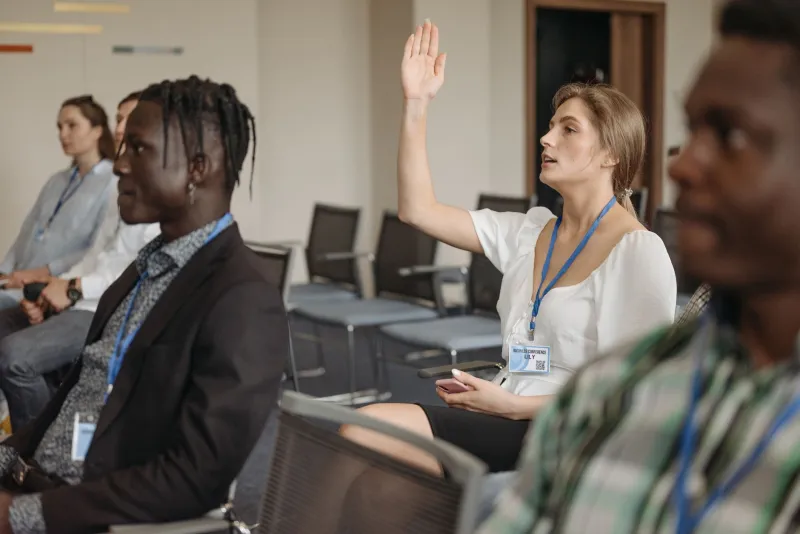
The Optional Microphone: Chairing Meetings Where Silence Isn't a Crime

Most UK meetings have a ritual. Someone glances at the agenda, smiles, and says: 'Shall we go round the table?' It sounds democratic. It sounds inclusive. And in plenty of rooms, it quietly derails the whole thing.
The round robin is not evil. It is just overworked. Used by default, it rewards the quickest talkers, pressures quieter colleagues to perform on the spot, and eats the agenda one update at a time. A sixty-minute meeting with eight people can lose half its time to a lap of 'nothing much from me' and 'just a quick update'.
If you chair meetings, you do not have to ban the round robin forever. You do need to stop using it as a substitute for design. Here is how to get contributions without the cringe.
The round robin is a comfort blanket, not a contribution plan
Chairs often reach for the round robin because it feels safe. It guarantees that nobody is overlooked. It gives everyone a turn. It avoids the awkwardness of asking one person to speak while others stay quiet.
But a turn is not the same as a contribution. The round robin can turn a meeting into a series of mini-presentations, with everyone waiting for their moment and nobody listening properly. The confident colleague uses it to think out loud. The quieter colleague uses it to survive. The person with the genuinely complex point runs out of time because the agenda has already been swallowed by status updates.
It also puts the chair in an impossible position. Do you cut someone off? Do you let the lap run long? Do you skip the person who looks like they would rather be anywhere else? The round robin creates these dilemmas because it makes speaking compulsory and contribution optional.
Do the first lap before the meeting
The simplest fix is to move the update out of the room. Ask for a short pre-read: one line per person, or one slide, or a shared document with three headings—done, next, stuck. Set a deadline. Then use the first five minutes of the meeting to summarise what you have read.
You might say: 'I've read the notes. Three things need a decision today, and two can wait. We'll start with the client risk.' That single move replaces the update lap and gives the room a clear job.
A pre-read also protects the people who need thinking time. Not everyone composes their best thoughts at speed, in front of an audience. Writing gives them a route in. If your team is allergic to documents, try a shared thread or a voice note. The format matters less than the principle: let people contribute before they are put on the spot.
Invite the right people, not every person
A meeting is not a census. You do not need a statement from every attendee on every item. You need the right voices at the right moment.
Try putting names against agenda items. 'Priya, could you take us through the supplier risk in two minutes? Then Tom, can you respond on budget?' This is not exclusion. It is pacing. It also signals to everyone else that they can listen rather than rehearse.
For quieter colleagues, a targeted invitation sent in advance is often kinder than a surprise turn. 'I'd value your view on the customer email—no need to prepare anything. I'll ask you after the data section.' That gives them time to gather their thoughts without making them feel singled out.
Make 'pass' a legitimate move
If you want real contributions, you need a real exit. 'Pass with purpose' means someone can decline their turn without having to invent a reason or apologise. The chair's job is to accept it cleanly.
Useful phrases include:
- 'No need to speak if you've nothing to add. Passing is fine.'
- 'You can pass—just say nothing to add, or I'll follow up in writing.'
- 'Thanks, noted. We'll come back to you if anything changes.'
The key is tone. Do not chase. Do not make a joke about someone being quiet. Do not say 'you're always so quiet' in front of the room. If the same person passes repeatedly, have a private chat. Ask whether the meeting format is working for them. There may be a practical reason—camera anxiety, a clashing deadline, or simply not being close enough to the work.
Keep the room moving without sounding like a schoolteacher
Chairs often worry that structure will make them sound brisk or bossy. It does not have to. Clear is kind. Try these in your next meeting:
- 'We'll skip the update lap today—the pre-read covers it. I'll flag anything that needs a decision.'
- 'Let's hear from the people closest to the work first, then open it up.'
- 'That's useful. Does anyone see it differently? One dissenting view is enough.'
- 'We've got five minutes left. Let's take one comment from someone who hasn't spoken, then close.'
- 'I'm going to pause the discussion there so we can land the decision.'
Notice what these phrases do. They set expectations without blaming anyone. They invite disagreement without demanding a performance. They give the chair permission to move on.
When the round robin still earns its place
The round robin is not banned. It works in some settings: a new team finding its feet, a weekly check-in where everyone needs a quick chance to flag pressure, a training session where each person is practising a skill. The difference is intent. If you use it, keep it short and say why.
Try one sentence each, with a timer. 'One sentence: what's on your plate this week?' Or use a traffic-light check: green, amber, red. Then move to the real agenda. The round robin should be a tool you choose, not a habit that chooses you.
The chair's real job
The chair is not a quizmaster. You are not there to make sure every person produces a sentence. You are there to make contribution easy, purposeful and safe.
Sometimes that means asking someone directly. Sometimes it means letting them pass. Sometimes it means replacing a lap of updates with a short pre-read and a sharper question. A meeting where three people say nothing but everyone leaves clear on the next step is usually better than one where eight people speak and nobody knows what was decided.
Clearer words, confident conversations. Start by giving silence a legitimate place in the room—and watch how much more useful the speaking becomes.